A suitable place
Bring land rights, soil, water and present use into one site decision. A map helps us ask better questions.
How land is assessedA proposal for Caribbean food resilience
From the Caribbean’s agricultural past to a practical next chapter for local food.
CaribVista starts with a question: how can land, farming knowledge and local organisation help more people eat well? Explore the histories behind the landscapes, then follow the proposal from research and practical training to a first locally led farm pilot.
Generalised orientation; markers are not project sites. Map data: Natural Earth.
01Why this idea exists
In Barbados, the sugar plantation economy reshaped land, work and trade through the labour of enslaved Africans. In Jamaica, emancipation also brought a struggle for land and the growth of independent small farming. The region’s food story includes both export estates and people growing for their own communities.
That history raises the question behind CaribVista: what would it take to support a new chapter of locally grown food, with farmers and households at its centre? The answer has to begin in a particular place, with the people and agricultural knowledge already there.
Historical context: Barbados’s heritage submission and the National Library of Jamaica.
Sugar reshaped Barbados's land, labour and trade. Alongside that plantation history runs another story: people growing provisions, keeping livestock and building livelihoods from the land.
Jamaica's farming story includes plantation estates and the free villages built around emancipation. Access to land gave families room to grow food, earn a living and shape their own futures.
Guyana’s coastal rice and sugar fields grew through generations of labour and enterprise. Beyond them, forests and savannas sustain different communities and food traditions.
02The intention
Food resilience depends on more than what grows. It depends on people who can farm it, water when it is needed, reliable buyers and a way for households to afford or receive the harvest.
The proposal is to connect those pieces in one locally led programme—and make the work, costs and results open to scrutiny.
Bring land rights, soil, water and present use into one site decision. A map helps us ask better questions.
How land is assessedPut farmers, practical training and qualified field support at the centre of daily production.
How the programme worksConnect harvests to buyers and households. Track the costs, the food delivered and the decisions behind it.
What success would meanThe landscape, in context
After the country story, the imagery adds another view: what the landscape looks like and how its vegetation signal changes. Pair those observations with farmers’ knowledge, field visits and land records to investigate a possible site.
From the satellite record
Explore the same landscape in natural colour and through its vegetation signal.
Sentinel-2 · January–September 2026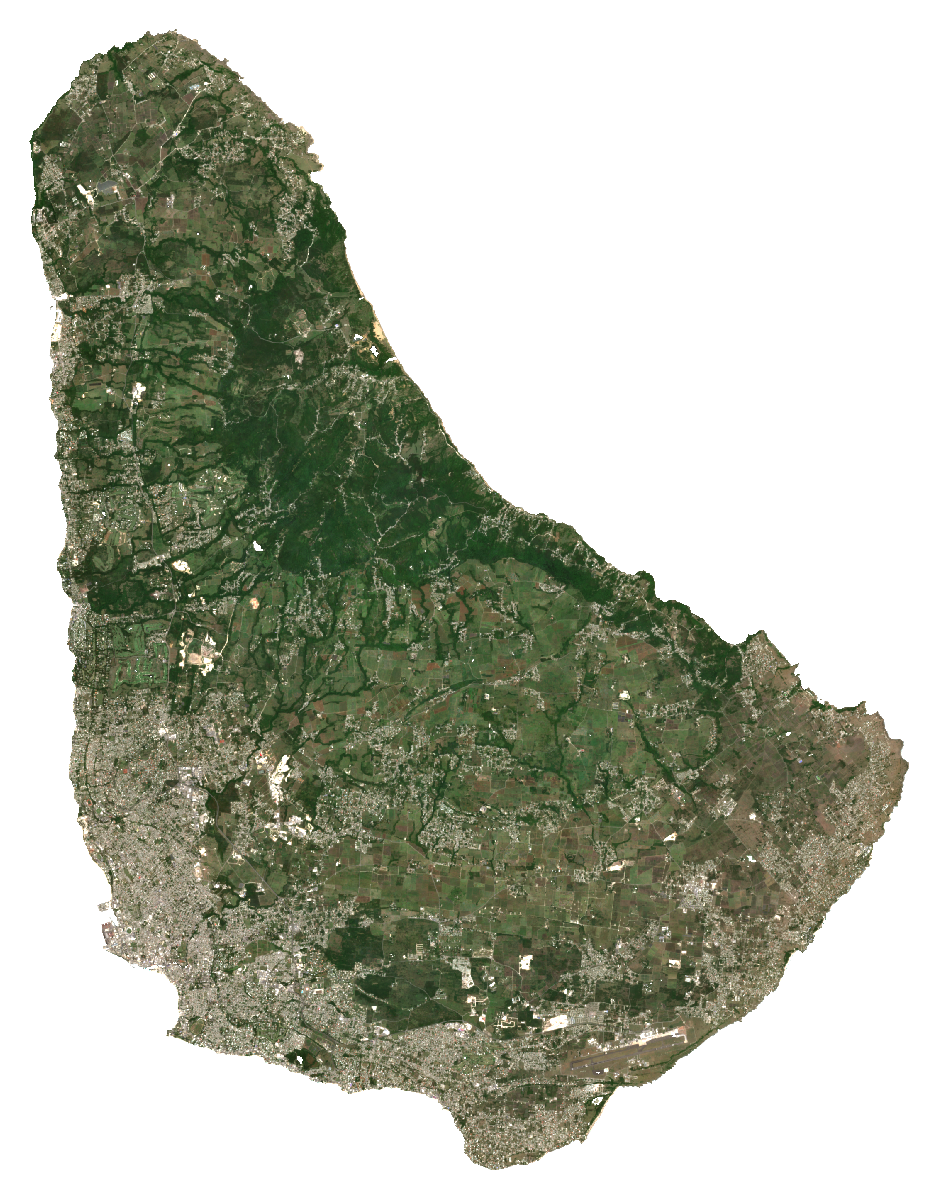
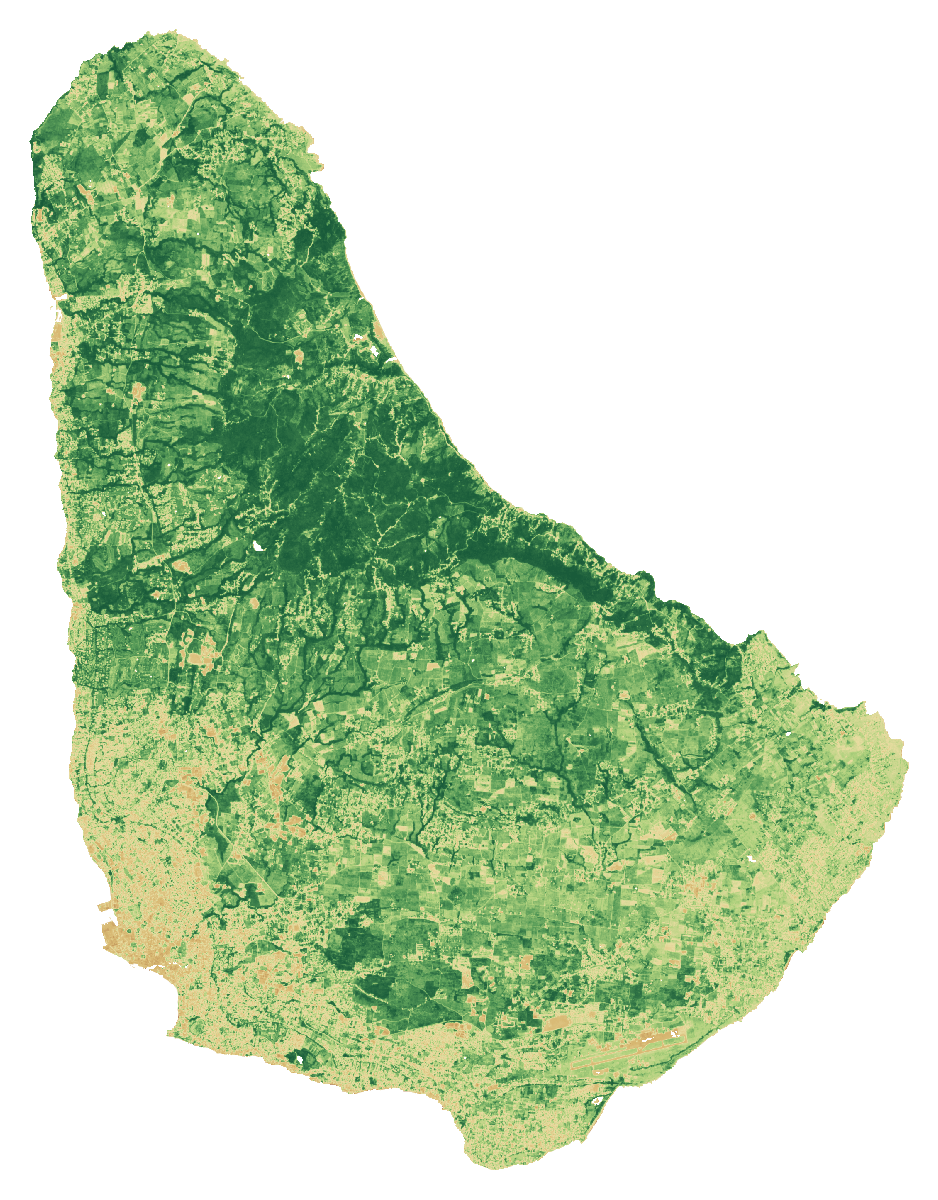 RGB · Natural colourBarbadosCloud-screened median composites
Stronger vegetation signals can include forests, pasture and crops. The dark background shows masked water, areas outside the study boundary or missing data.
A monitoring example · Barbados
Each point is the spatial mean of that month’s median NDVI over observed grid cells. Different months can have different clear views.
NDVI axis: 0 to 1. Seasonal conditions, cloud screening and changes in observed cells can influence this line. It is not a measure of harvests, crop health or available land.
| 2026 month | Mean NDVI | Observed cells | Grid-cell coverage | Source granules |
|---|---|---|---|---|
| Jan | 0.621 | 412 / 416 | 99.0% | 10 |
| Feb | 0.590 | 413 / 416 | 99.3% | 11 |
| Mar | 0.539 | 410 / 416 | 98.6% | 9 |
| Apr | 0.462 | 397 / 416 | 95.4% | 7 |
| May | 0.412 | 415 / 416 | 99.8% | 14 |
| Jun | 0.344 | 342 / 416 | 82.2% | 11 |
| Jul | 0.537 | 408 / 416 | 98.1% | 13 |
| Aug | 0.529 | 416 / 416 | 100.0% | 12 |
| Sept | 0.597 | 416 / 416 | 100.0% | 12 |
Coverage refers to cells on this fixed grid, not national area coverage or classification accuracy. Monthly medians cannot be averaged to reproduce the full-period median. The monthly grid is pinned separately from the archived screening calculation.
Download the monthly values and method ↓Natural colour combines the red, green and blue bands (B4, B3, B2). NDVI compares near-infrared and red reflectance: (B8 − B4) / (B8 + B4). Both views use the same dated scene list and extent, with cloud and shadow screening. Each pixel summarises observations across the period; this is not a single photograph.
The colour scale is fixed across countries; values beyond its endpoints use the endpoint colours. The separate NDVI statistic is the spatial mean of the temporal-median index on the documented 1 km screening grid. Image pixels use the display grid stated above.
These views help guide a closer inspection. They do not identify available rental land, confirm ownership or measure agricultural suitability.
Download the imagery reproduction package ↓
Contains modified Copernicus Sentinel data (2026), processed for CaribVista.
The next step is to connect an observed landscape to the soil, water, rights and people a workable farm would depend on.
From observations to a site decisionFrom a regional idea to a local test
A first pilot should be sized around real land, water, skills and demand. Barbados is an initial preparation candidate; its site and scale remain to be established.
Read the pilot approachA willing local partner, clear land rights and a team responsible for daily delivery.
Site tests, crop choices, buyers and a budget built from current evidence.
Harvests, paid work, cost per kilogram, food access and environmental outcomes.
Use the results to expand, revise or stop—not to assume a regional rollout.
03Across the region
Follow each country’s agricultural history, the pressures and possibilities facing its farmers, and the place CaribVista could have in that story. Then explore the land research and practical next steps.
Find a countryThe next conversation
Bring a local delivery team, a candidate site or a route to customers and households. Together, the next task is to agree the preparation work, its responsibilities and its budget.
Discuss a preparation partnershipAn invitation to prepare a project. Sites, funding and operating partnerships are still to be agreed.